
The Future of Marketing Automation: AI for Marketing Operations
.jpg)
How Tildei’s AI agents transform marketing operations
This is the first part of a two-part series on how Tildei’s AI agents transform marketing. We’re starting behind the scenes, with the workflows and operations that keep campaigns moving.
Most marketing teams aren’t held back by a lack of ideas. They are held back by the work required to execute them.
Marketing teams are drowning in busywork
In 2025, this is the marketing reality: marketers are juggling 12–20 tools in a typical stack, yet most teams still struggle to integrate data across systems. Many spend hours every week checking data quality, reconciling spreadsheets, and chasing updates. Despite the AI hype, only a small minority actually use AI to automate workflows end-to-end, the kind of automation that really changes the workload.
At the same time, complexity keeps rising:
- Dozens of channels to monitor
- Siloed partners and platforms
- Intake requests via email, Slack, forms, and meetings
- Leadership asking in every QBR: “So… how are we leveraging AI to be more efficient?”
The gap between what marketers could do and what actually gets done is a workflow problem, not a creativity problem.
A very 2025 marketing operations day (and why it needs to change)
Picture a typical day in your team:
- Your lifecycle marketer is exporting last week’s email performance into a CSV, pulling in Google Analytics, and highlighting trends so the content team can “quickly” see what’s working.
- Support closes a ticket where a customer mentions it’s their anniversary next Thursday: that nugget of context dies in the help desk instead of flowing into marketing.
- Meanwhile, a detailed Reddit post about your product, full of praise, concerns, and language you wish you’d thought of, slides by unnoticed because no one has time for social listening today.
Each of these moments could have sparked a smarter campaign, tighter messaging, or a better customer experience. Instead, they become missed opportunities because teams are buried in manual coordination.
Now imagine the same day with an AI marketing agent quietly running in the background:
- The second that Reddit post appears, your AI agent runs sentiment analysis, extracts key concerns, maps them to your goals, and drops a short briefing into your #marketing channel:
“Customer anxiety around packaging; consider unboxing content to clarify expectations.” - When the anniversary-related support ticket closes, the agent parses the message, captures “anniversary next Thursday,” and updates the customer’s profile in Braze, Attentive, Salesforce Marketing Cloud, wherever you market. It then queues them for a timely, personalized offer.
- Weekly performance reports? The agent compiles, formats, and sends them every Monday morning without anyone exporting a single CSV.
Same tools, same data, but now the orchestration isn’t sitting on your team’s shoulders.
That’s the shift from manual marketing operations to autonomous marketing operations.
What autonomous marketing agents actually are (and aren’t)
An autonomous marketing agent is not just another chatbot. It’s not a set of rigid rules that break every time something unexpected happens.
A Tildei AI agent is a software teammate that can:
- Perceive what’s happening across your channels, systems, and data streams
- Reason using your goals, rules, and brand knowledge
- Act to move a workflow forward, without a human nudging every step
Give it a goal and some guardrails, and it breaks the work into subtasks: monitor signals, analyze, update profiles, trigger campaigns, generate reports. It keeps going until the objective is reached, or until a human chooses to step in.
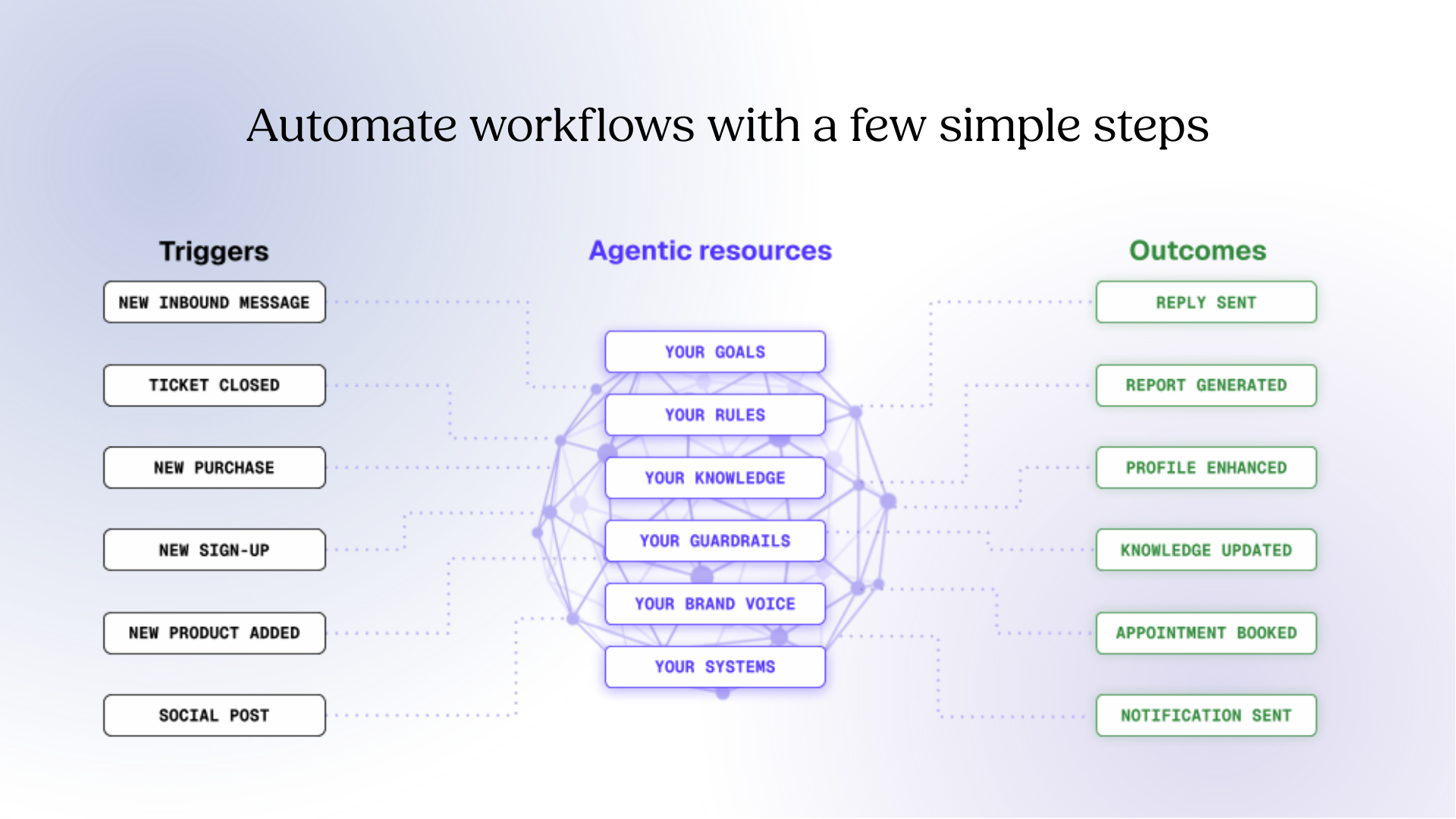
In this series, we’ll look at these agents both as always-on marketing-ops teammates and as brand ambassadors in customer-facing journeys. In Part 1, we’re focused on the former: how they support internal marketing operations day in, day out.
From triggers to outcomes: the core marketing operations use cases
1. Customer Sentiment Analysis – from social signal to action
A social post appears, say, a detailed Reddit thread. A traditional tool might flag it or send an email alert, then it waits.
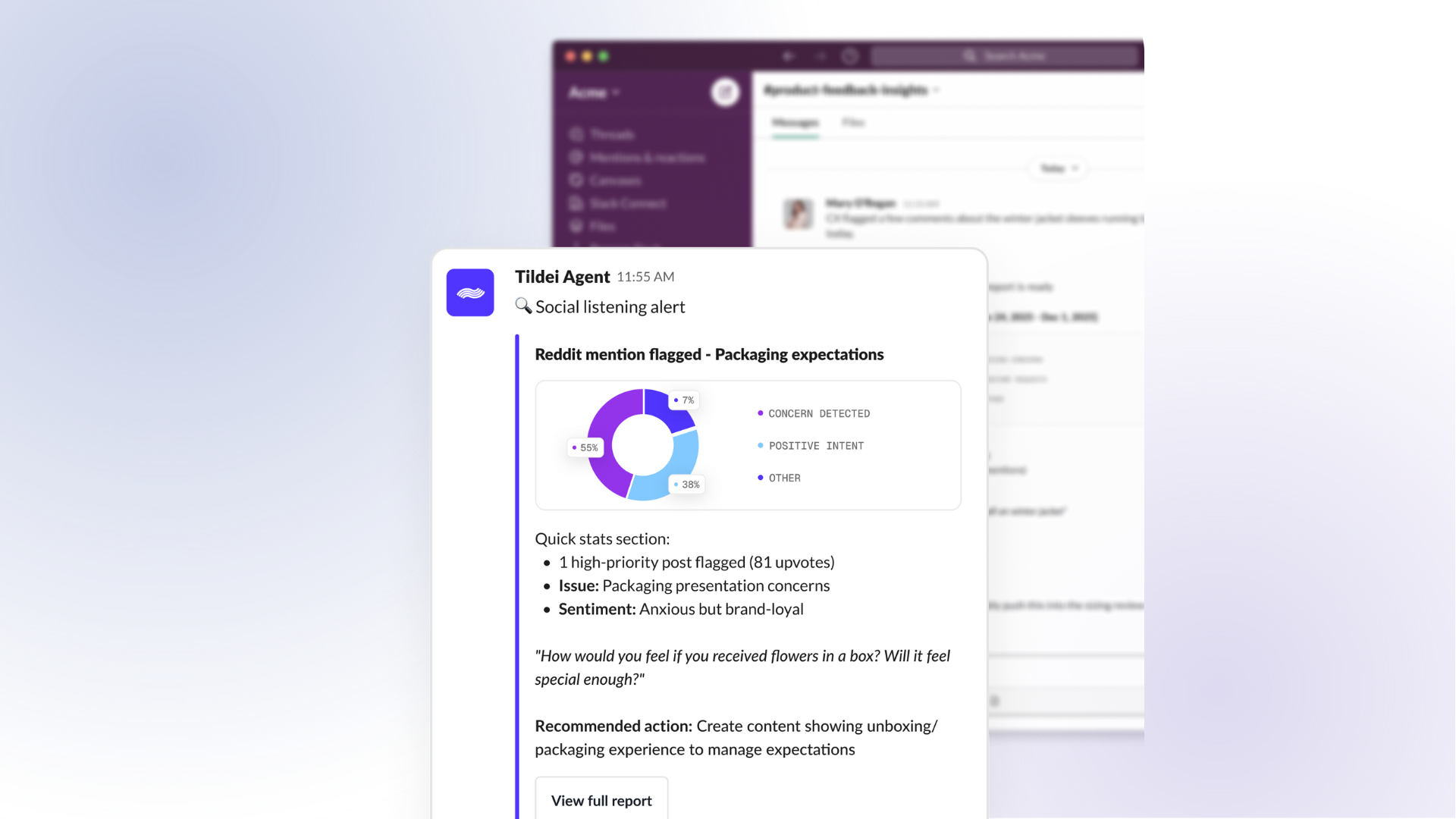
A Tildei Operational Agent:
- Detects the new post
- Analyzes sentiment and extracts key themes (e.g. concerns about packaging)
- Cross-checks your rules (e.g. “flag packaging issues,” “prioritize high-value or high-reach users”)
- Generates a concise insight report
- Pushes it into the right internal channel (Slack, email, task tool)
- Optionally creates a ticket or adds it directly to your campaign backlog
No one had to be “on Reddit duty”. The signal is captured, interpreted, and turned into next steps, end to end.
2. Post-Support Progressive Profiling – connecting CX to marketing

Support closes a ticket:
“Can my order get to Columbus by Thursday? It’s my anniversary and I don’t want it to be late.”
Traditionally, that context lives and dies in the help desk. If you’re lucky, someone adds a note to the CRM.
With Tildei, the agent:
- Reads the closing conversation
- Extracts the relevant details (anniversary, date, location)
- Writes them into the customer’s profile across your marketing platforms
- Can automatically queue them for a future anniversary-related campaign or a one-off surprise
You’ve just converted a one-off service interaction into durable, usable marketing intelligence.
3. Social Listening & Opportunity Identification – turning noise into ideas
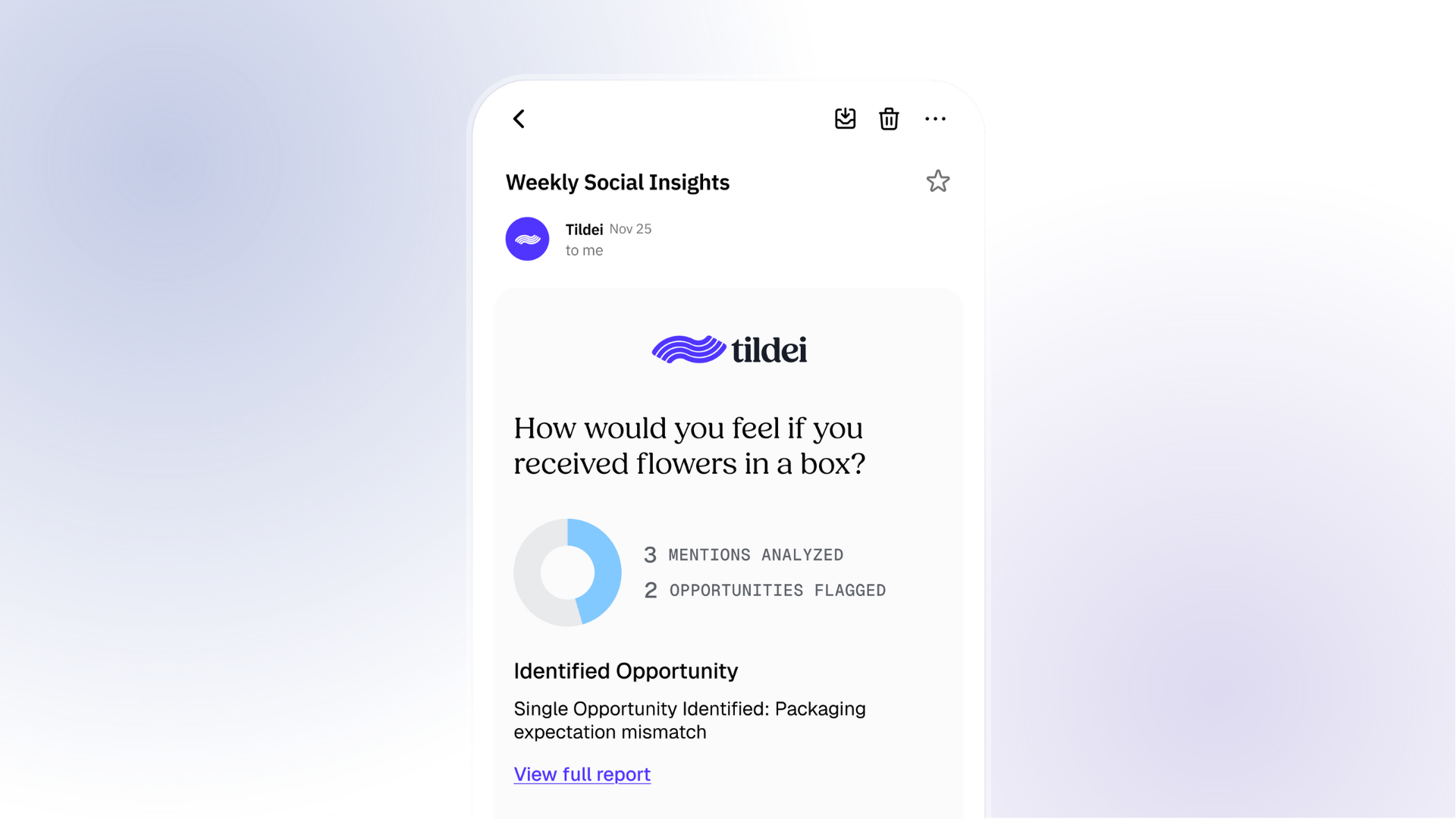
Think of posts like:
“How would you feel if you received flowers in a box?”
A Tildei AI agent doesn’t just classify this as “neutral” or “question”. It:
- Reads the full conversation
- Identifies the underlying anxiety (“will this feel special enough?”)
- Writes a mini-report under “Identified opportunities” (e.g. Expectation gap → show unboxing and packaging in content)
- Routes this directly to the brand or content owner
Instead of someone trawling forums for hours, your agent continuously scans, summarizes, and surfaces specific ideas your team can act on.
4. Conversation Analysis & Product Feedback – catching moments of delight
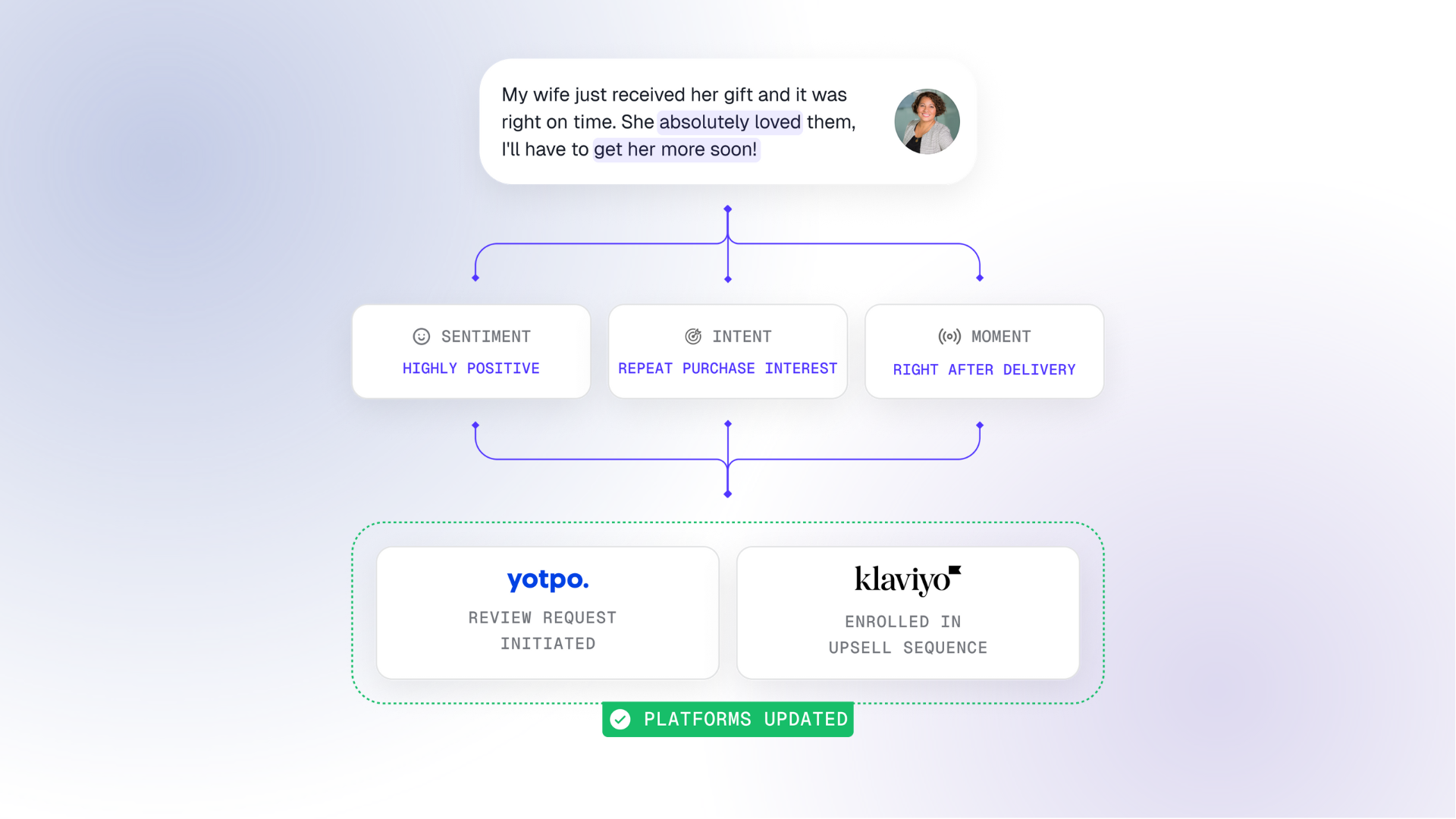
A customer says:
“My wife just received her gift and it was right on time. She absolutely loved them, I’ll have to get her more soon!”
The Tildei AI agent:
- Detects positive sentiment and purchase intent
- Reconciles that with the customer’s history
- Triggers a review request or an upsell journey at exactly the right moment, via the channel that works best for that person
Your team doesn’t need to read every transcript, the agent spots the moment and acts.
Across all these, it’s the same backbone: from trigger → reasoning → outcome.
Why Tildei?
So why choose Tildei instead of just adding another tool to an already crowded stack?
Because Tildei isn’t “one more tool”, it’s the agent layer that sits on top of the tools you already use.
- Cross-stack intelligence
Agents tap into your CRM, help desk, analytics, marketing platforms, and internal documents. No more copy-paste or CSV gymnastics. - True workflow automation
Tildei doesn’t stop at alerts. It carries the work from trigger to completed action: updated profiles, generated reports, launched journeys. Your team reviews, adjusts, and steers, but doesn’t have to push every button.
Fast path to value
You don’t need a year-long AI project.
.png)
You start small, prove value quickly, and scale up what works.
Build powerful marketing agents. Activate them everywhere.
Marketing automation started as “send emails on a schedule”.
We’re now at the point where you can delegate entire workflows to AI agents that think and act like experienced members of your team, across operations and engagement, on top of the stack you already have.
When operations start to run themselves, your team can focus on what really matters: shaping great customer journeys. In Part 2, we’ll flip the lens and show how the same AI agents work on the front line as always-on brand ambassadors.
That’s the future we’re building at Tildei:
Build powerful marketing agents. Activate them everywhere.
If you’re ready for your marketing operations to move from manual to autonomous, without ripping out your stack, let’s talk about what your first agent could do. Book a demo here.